
Doppler-based Laser-Induced Fluorescence Diagnostics for Velocity Distribution Measurements
Advanced Diagnostics Navigation
- Atomic and molecular species, positive and negative ions
- Laser-Induced Fluorescence (LIF) and Two-Photon Absorption LIF (TALIF)
- Radar Resonant Enhanced Multi-Photon Ionization (Radar REMPI)
- Characterization of plasma, chemical composition and dynamic behavior
- Electron velocity distribution function, gas flow velocity and temperature
- Electric field and space potential
- Nanoparticle Diagnostics
- Surface Diagnostics
Doppler-based Laser-Induced Fluorescence Diagnostics for Velocity Distribution Measurements
Laser-Induced Fluorescence (LIF) spectroscopy is a noninvasive laser diagnostic that enables species-selective measurements of velocity distribution functions (VDFs) in complex plasmas. It is used in laboratory and industrial plasma systems, including plasma processing, electric space propulsion, and semiconductor manufacturing. In single-photon LIF, a tunable laser is tuned to a resonant electronic transition of a selected species (atoms, ions, or molecules). Only particles that satisfy the resonance condition absorb photons, are excited, and then emit fluorescence photons during spontaneous decay. By scanning the laser wavelength across the transition and measuring fluorescence at each discrete wavelength, a fluorescence spectrum is obtained. At low pressure and under moderate electric and magnetic fields, Doppler broadening from particle motion is typically the dominant broadening mechanism. The measured spectrum resembles the VDF, enabling the extraction of temperature, mean velocity, and most probable velocity. With proper calibration, absolute or relative density can also be determined. In some cases, electric and magnetic fields can be measured through Stark and Zeeman effects, respectively.In practical LIF implementations, excitation often starts from a metastable state, which is a long-lived excited level populated primarily by electron-impact collisions. Metastable populations are typically sufficient in studied plasmas. If ground-state properties are inferred from metastable measurements, thermal or collisional equilibrium between metastable and ground states must be assumed.
The PPPL LIF system supports Doppler-shift LIF for VDF characterization with a velocity resolution of 60 m/s and a detection limit around 1014 m-3 .
PPPL capabilities are based on three tunable diode lasers:
- the TLB-6917 series New Focus laser (center vacuum wavelength 834.95 nm)
- the Toptica DLC DL PRO 670 (tuning range 660–673 nm)
- the Toptica DLC DL PRO 730 (tuning range 728–731 nm)
These lasers cover transitions for excitation and available configurations include:
- Ar ions and atoms, Kr ions, Xe ions and atoms, and He and Li atoms
- point measurements using a photomultiplier tube (PMT)
- two-dimensional measurements using an iCCD camera
- time-resolved operation
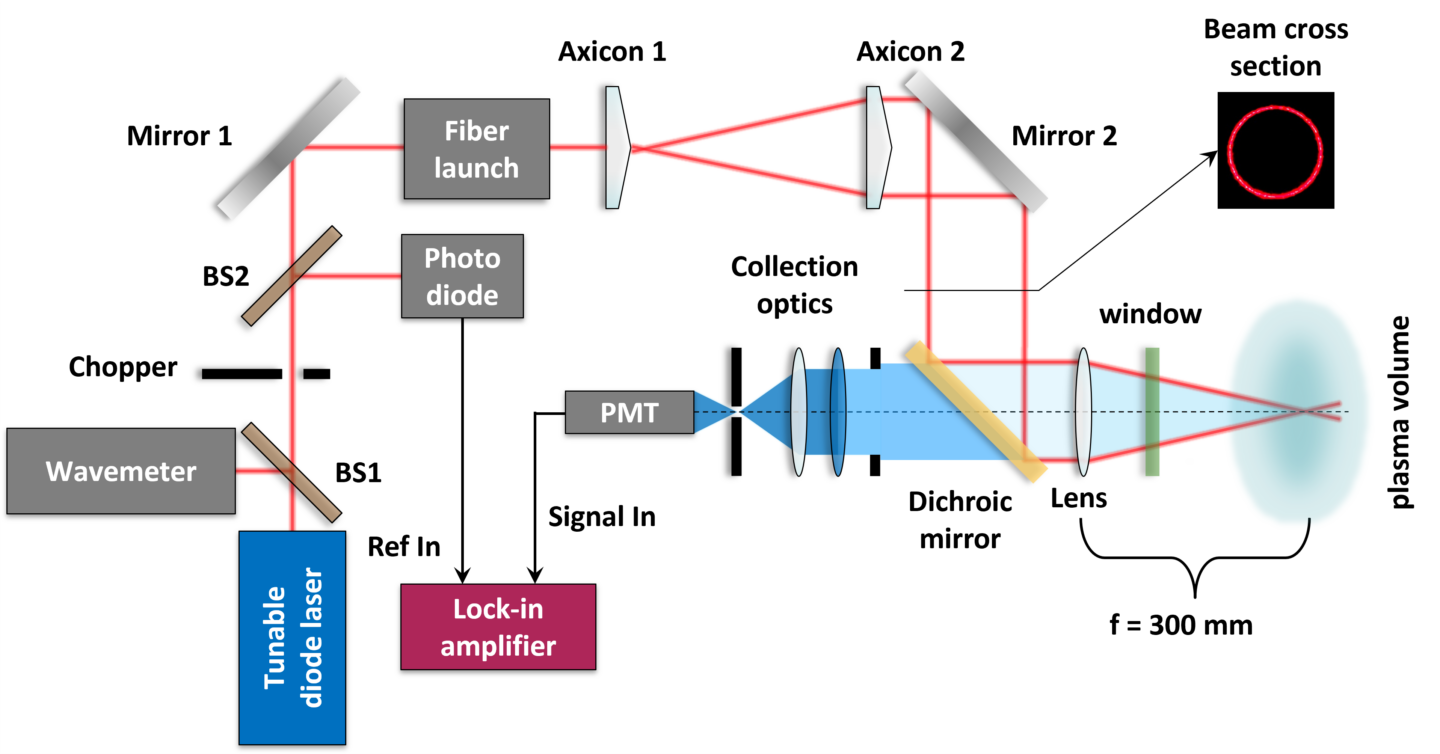
- a confocal configuration for plasmas with limited optical access (spatial resolution ~1 mm)
- two-dimensional VDF measurements using orbital-angular-momentum beams
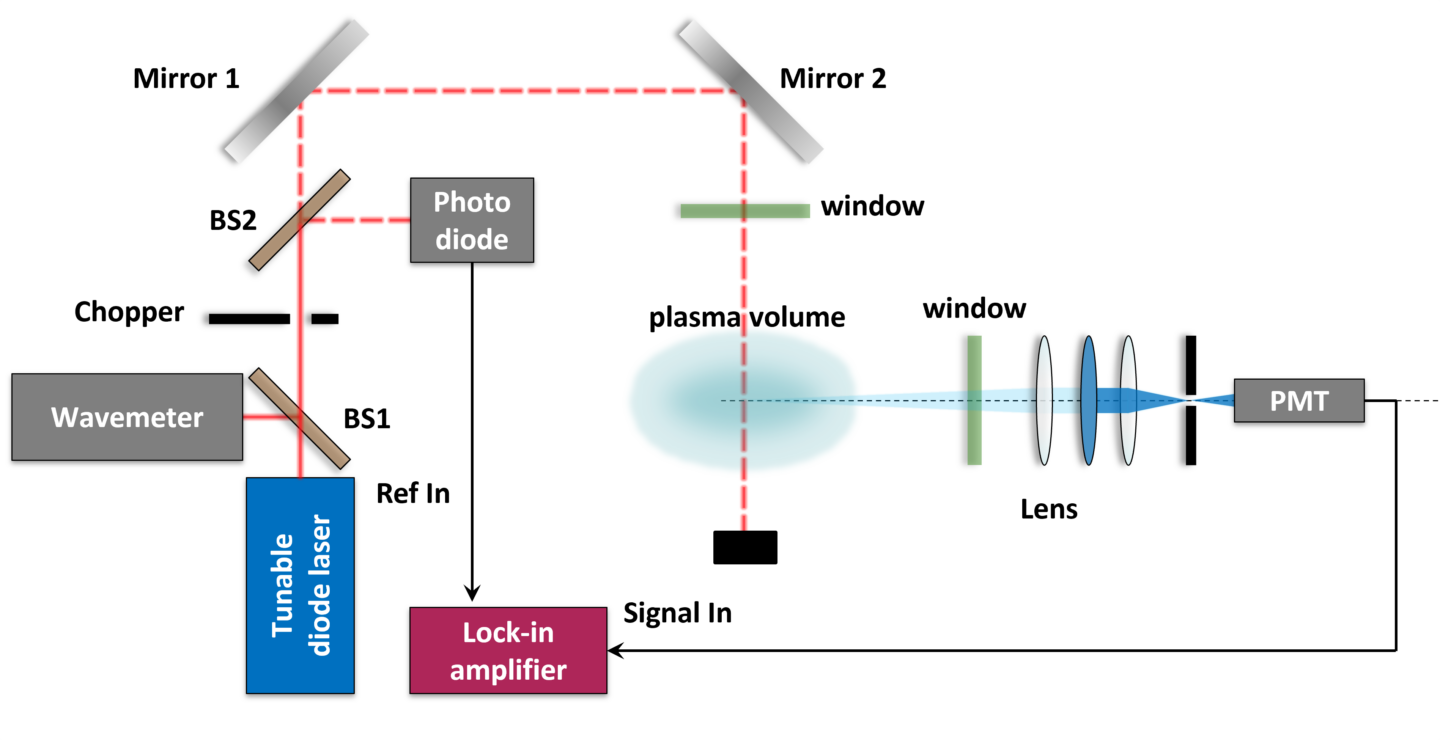
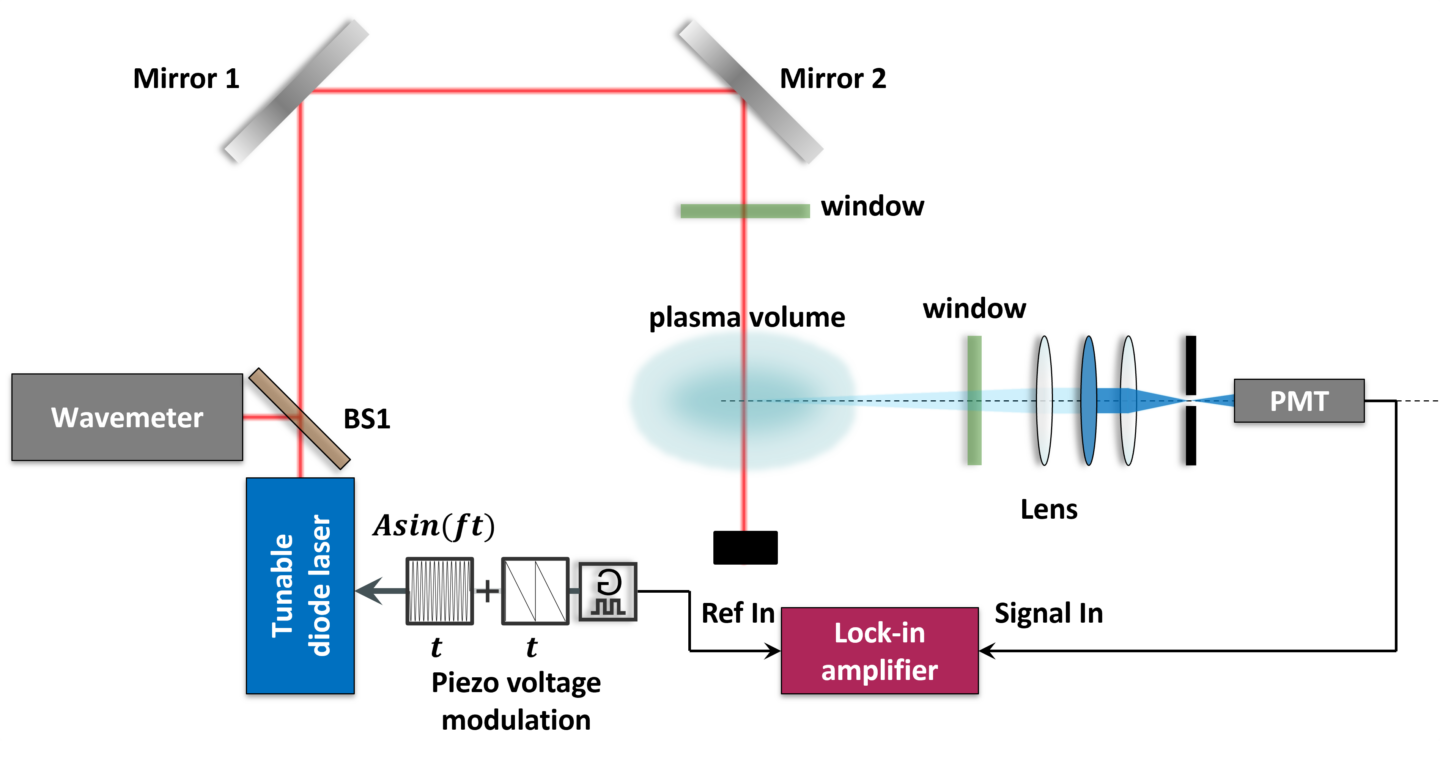
- High sensitivity is achieved using lock-in detection in amplitude-modulation or wavelength-modulation configurations.
entrance. This allows for diagnostic of optically obstructed plasma systems. The diagrams of both setups are shown below.
Conventional LIF configuration with collection optics at 90 degrees with respect to the beam propagation
Wavelength modulation LIF configuration with collection optics at 90 degrees with respect to the beam propagation
Confocal LIF configuration with coaxial collection at 180 degrees wrt the beam propagation
 This capability is located at the Princeton Plasma Physics Laboratory.